
Hydrogen and electric mobility
Hydrogen and electric mobility become tractable only when vehicles, stations, renewable supply, storage, delivery logistics, markets, and utility constraints are treated as one service network rather than isolated devices.
Research scope
I study the planning and operation of hydrogen refuelling and electric-mobility infrastructure, including renewable production, heterogeneous and backup storage, parallel dispensers, fuel-cell and electric-vehicle demand, delivery delays, electricity support, and market interaction.
Research objectives
The objective is to identify viable sizing, allocation, scheduling, and control policies that preserve mobility service under uncertain demand and delayed supply while managing operating cost, state transitions, component stress, and environmental impact.
Refuelling control
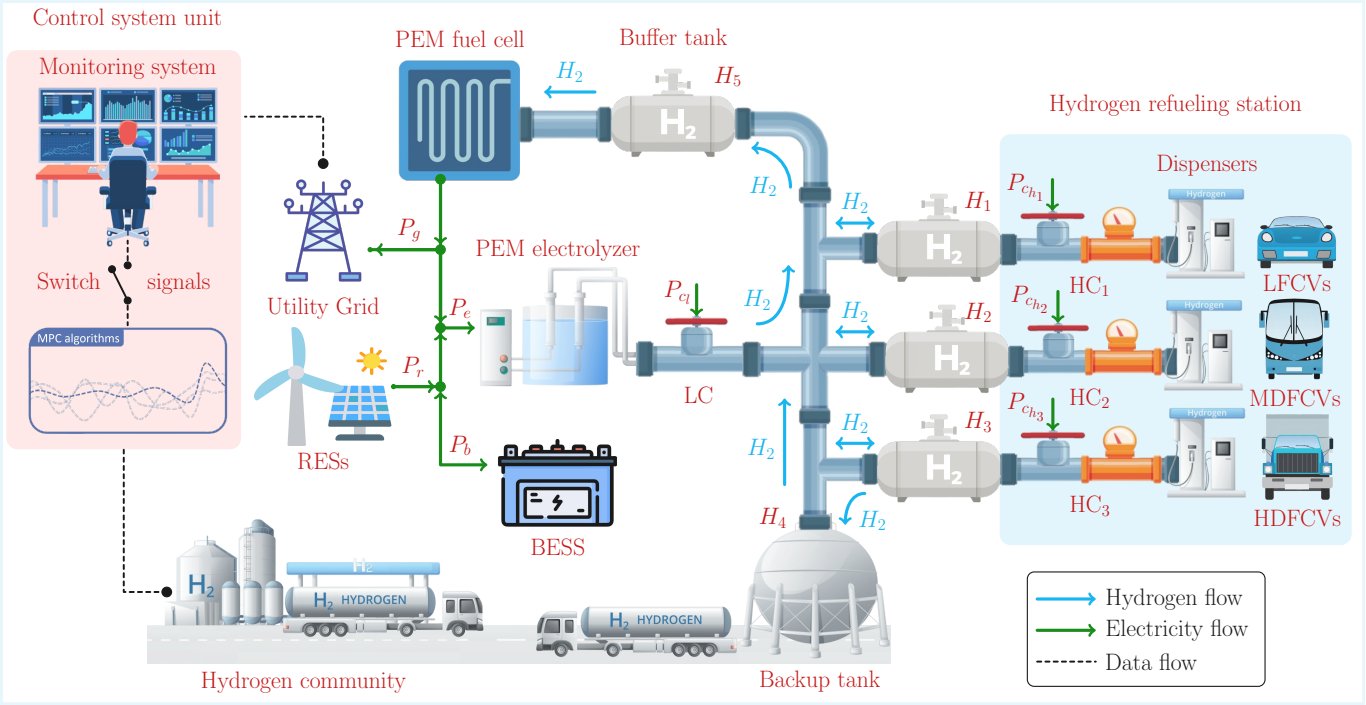
The control architecture coordinates renewable production, electrolysis, heterogeneous storage, electricity markets, backup hydrogen, and parallel service for light-, medium-, and heavy-duty vehicles while preserving operation during demand uncertainty and supply delays.
Experimental validation
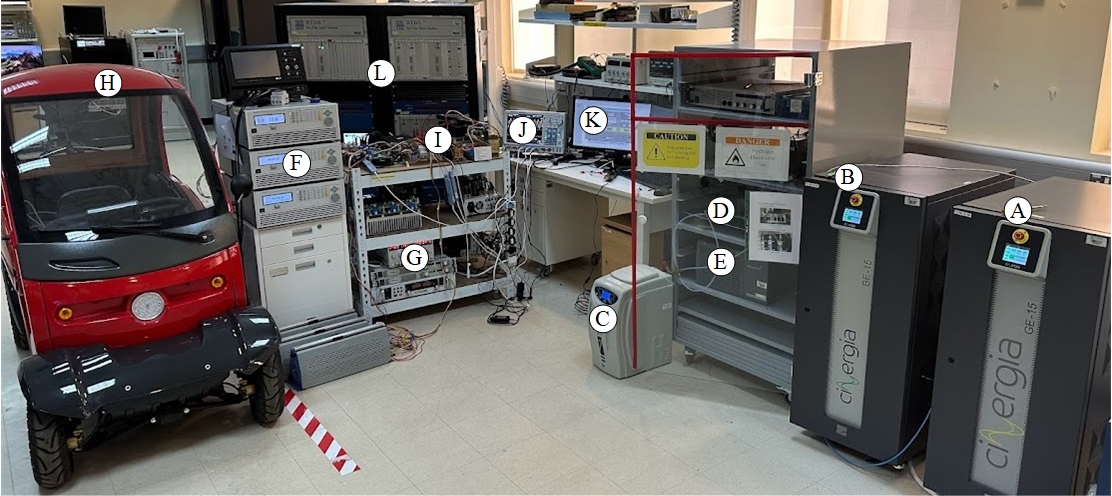
Vehicle emulators, real-time control, communication interfaces, measurement systems, and power hardware test whether mobility-control decisions remain feasible under the implementation constraints hidden by simulation alone.
Selected publications
2026 · IEEE Transactions on Industry Applications
Optimal configuration and coordinated scheduling for hydrogen-based mobility in green transit networks: dispatchable operations and storage control
Publisher (opens in a new tab)2026 · IEEE Transactions on Transportation Electrification
Robust economic MPC for coordinated dispatch management in hydrogen refueling systems incorporating flexibility market
Publisher (opens in a new tab)2026 · Applied Energy
Unified control architecture for resilient hydrogen mobility with heterogeneous storage under realistic market logistics delays
Publisher (opens in a new tab)2026 · Journal of Cleaner Production
Resilient planning and operational management of renewable-integrated hydrogen refueling stations with multiple storage units under delivery delays
Publisher (opens in a new tab)2025 · eTransportation
Optimizing resilient parallel refueling operations: relaxed stochastic economic mobility scheduling for fuel cell vehicles with multiple hydrogen storage systems
Publisher (opens in a new tab)2026 · Applied Energy
Data-driven optimization of hybrid EV charging infrastructure: from cross-city demand forecasting to dynamic allocation
Publisher (opens in a new tab)
Research and facilities
Documented research appointment
Vehicle-to-grid research at Chalmers
The mobility theme also includes a visiting-research appointment on vehicle-to-grid systems at Chalmers University of Technology.
ViewExperimental environment
ESCO Lab mobility testbed
Vehicles, emulators, real-time control, communication, and measurement equipment expose the implementation constraints hidden by simulation alone.
View
Research opportunities
Research enquiries may address hydrogen production and refuelling, charging demand, infrastructure allocation, storage scheduling, logistics uncertainty, or experimental mobility control. No funded vacancy or fixed deadline is implied.