
Optimal and data-driven control
My control research asks how complex energy systems can make reliable decisions at the speed of the physical process without losing the longer view of markets, degradation, uncertainty, and infrastructure planning.
Research scope
I study optimal, robust, stochastic, economic, and data-informed control for cyber-physical energy systems. The work spans receding-horizon and multi-timescale model predictive control, hybrid-system validation, grid-forming inverter control, renewable microgrids, electrolysers, and hybrid storage.
Research objectives
The objective is to coordinate planning and real-time action while keeping physical constraints, stability, component health, and computational effort visible. Data is introduced where it improves prediction, state estimation, or adaptation; it does not replace the structure supplied by physics and control theory.
Control architecture
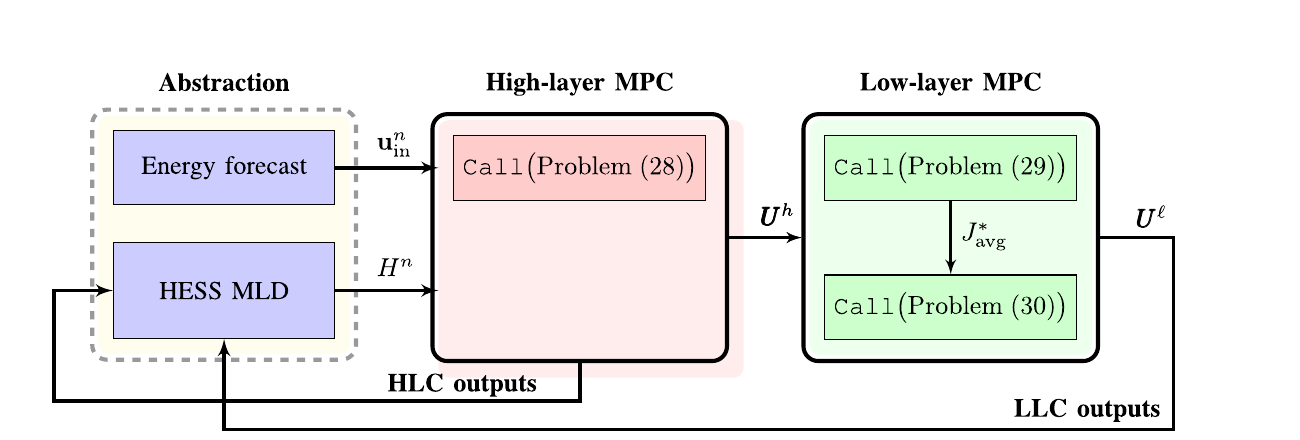
The multi-layer predictive-control architecture separates long-horizon scheduling from short-horizon correction. Forecasts, operating states, device constraints, and physical transients remain coordinated without being forced into one timescale.
Experimental validation
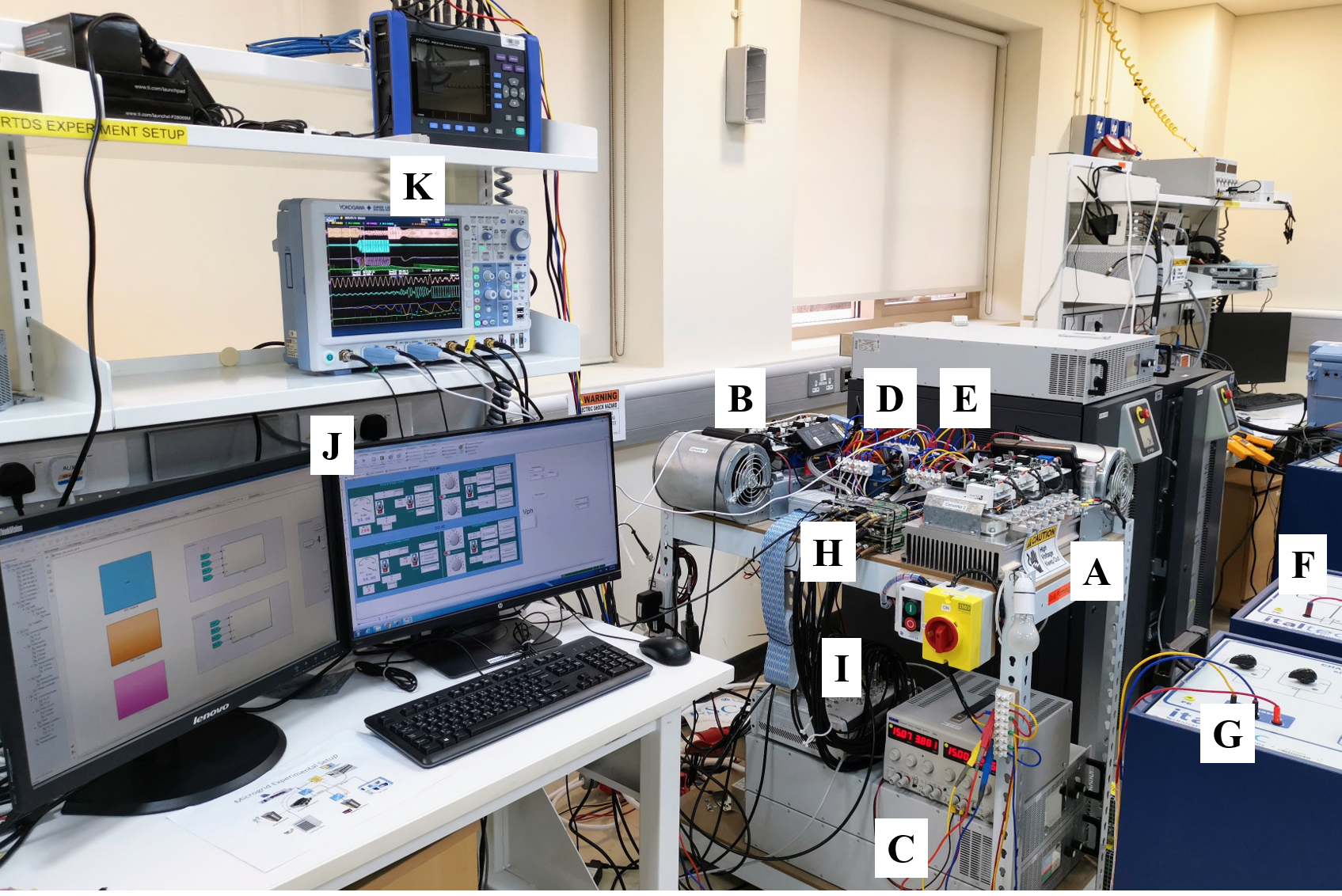
Real-time simulation and converter hardware expose delay, saturation, measurement noise, current limits, and computation time, providing direct evidence of whether the controller remains credible beyond its numerical model.
Measured performance
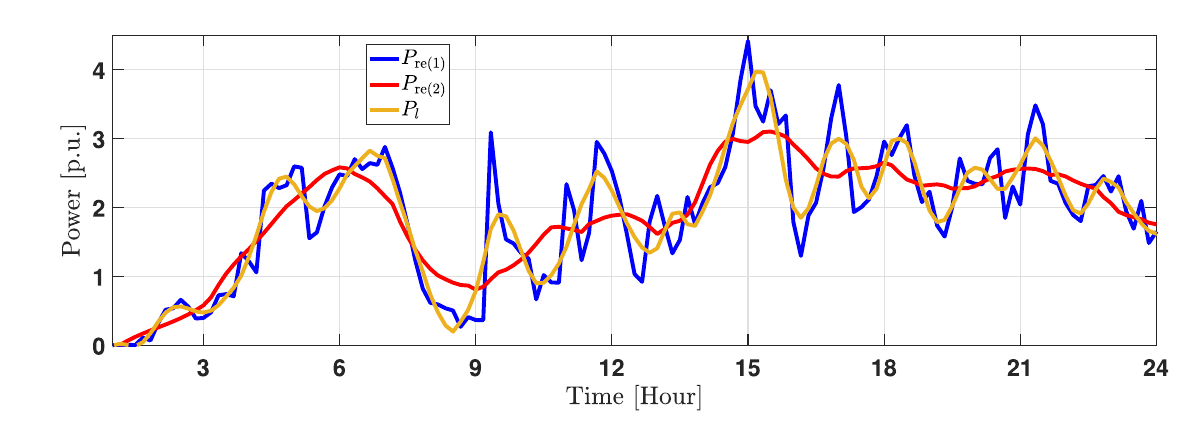
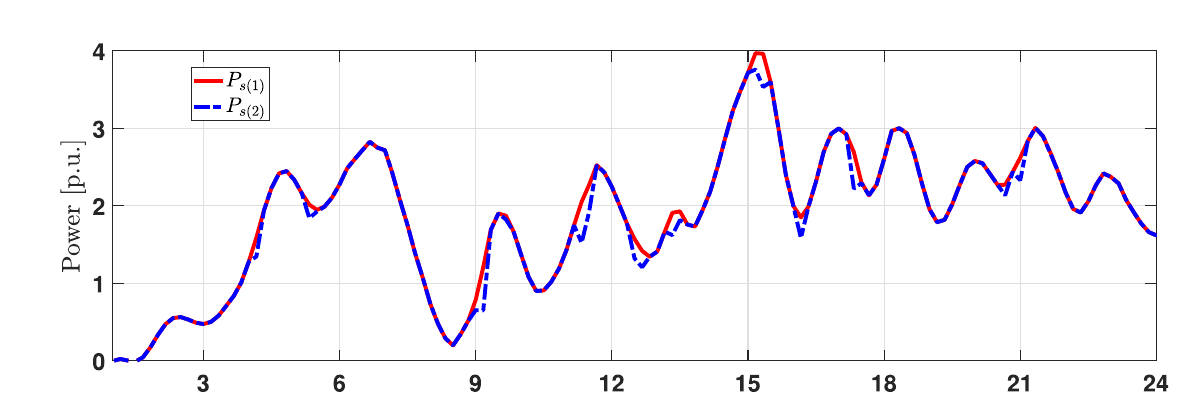
Renewable-generation and load profiles define the experimental operating problem, and the measured emulator response shows how closely the controller follows the requested demand across the complete profile, including its steepest changes.
Selected publications
2026 · IEEE Transactions on Industry Applications
Scalable receding horizon control for output grid power smoothing in microgrids with hybrid energy storage systems
Publisher (opens in a new tab)2026 · IEEE Transactions on Industry Applications
Economic model predictive control for PEM electrolyzers with DC/DC interface supporting flexible power point tracking
Publisher (opens in a new tab)2026 · IEEE Control Systems Letters
Finite-trace cellular sheaves for validation and estimation of hybrid dynamical systems
Publisher (opens in a new tab)2024 · IEEE Transactions on Industrial Informatics
A coordinated multitimescale model predictive control for output power smoothing in hybrid microgrid incorporating hydrogen energy storage
Publisher (opens in a new tab)2025 · IEEE Transactions on Smart Grid
Decentralized cost-based dispatchable virtual oscillator control for grid-forming inverters
Publisher (opens in a new tab)2026 · Applied Energy
Data-driven optimization of hybrid EV charging infrastructure: from cross-city demand forecasting to dynamic allocation
Publisher (opens in a new tab)
Projects and facilities
Experimental environment
ESCO Lab
Real-time simulation, power converters, vehicle emulators, and measurement hardware provide the experimental layer for controller validation.
ViewCurrent funded project
Autonomous renewable-hydrogen microgrids for Arctic communities
Digital twins, model-predictive and fault-tolerant control, diagnostics, and resilience assessment are brought together for isolated polar infrastructure.
View
Research opportunities
Expressions of interest are welcome from researchers working in predictive control, hybrid systems, learning-assisted control, grid-forming systems, and experimental validation. Availability and funding are confirmed individually.